Cost guide · Texas
How Much Does Water Softener Installation Cost in Texas? (2026 Guide)
Water softener installation in Texas typically costs between $1,200 and $3,800 for a standard whole-home salt-based system, including equipment and professional installation.
Updated 12 min read
Quick answer · Typical Texas pricing
$1,200–$3,800
Standard salt-based system, installed
≈ $2,500
A reasonable starting budget for many Texas homes
$4,000+
Complex installs, premium equipment, or added plumbing
More complex installations, premium equipment, or additional plumbing work can push the total above $4,000. For many Texas homeowners, a budget of approximately $2,500 is a reasonable starting point. The final price depends on your home’s plumbing, water hardness, household size, and the system you choose. Whether you’re dealing with mineral buildup in Austin, cloudy shower doors in Dallas, or hard water in Central Texas, understanding installation costs can help you avoid overpaying for equipment you don’t need.
Here’s what Texas homeowners should know before purchasing a water softener.
Average Water Softener Installation Cost in Texas
The cost of installing a water softener varies based on the equipment and complexity of the installation. The following ranges are useful budgeting estimates based on published national installation costs and Texas market pricing.
| System type | Estimated installed cost |
|---|---|
| Standard salt-based water softener | $1,200–$3,800 |
| High-efficiency water softener | $2,500–$4,500 |
| Dual-tank water softener | $1,700–$5,000 |
| Salt-free water conditioner | $1,500–$4,500 |
These are estimated equipment-and-installation ranges, not fixed Clearly Water Systems prices or a statewide average based on completed Texas installations.
A traditional salt-based softener is often the most practical option for households experiencing significant hard water problems. A salt-free conditioner may be appropriate for homeowners primarily interested in limiting certain types of scale buildup, but it does not actually remove water hardness minerals.
The best system isn’t necessarily the most expensive. It’s the one properly sized for your water conditions and household demand.
How Much Does Water Softener Installation Labor Cost?
If you’ve already purchased a water softener, you’ll still need to account for installation labor, fittings, and any plumbing modifications.
Published pricing from a Dallas–Fort Worth plumbing contractor puts standard installation labor at approximately $550 to $1,700, depending on the work involved. Straightforward installations may cost less, while extensive plumbing modifications can cost considerably more.
One of the biggest factors is whether your home already has a water softener loop.
Homes with an existing water softener loop
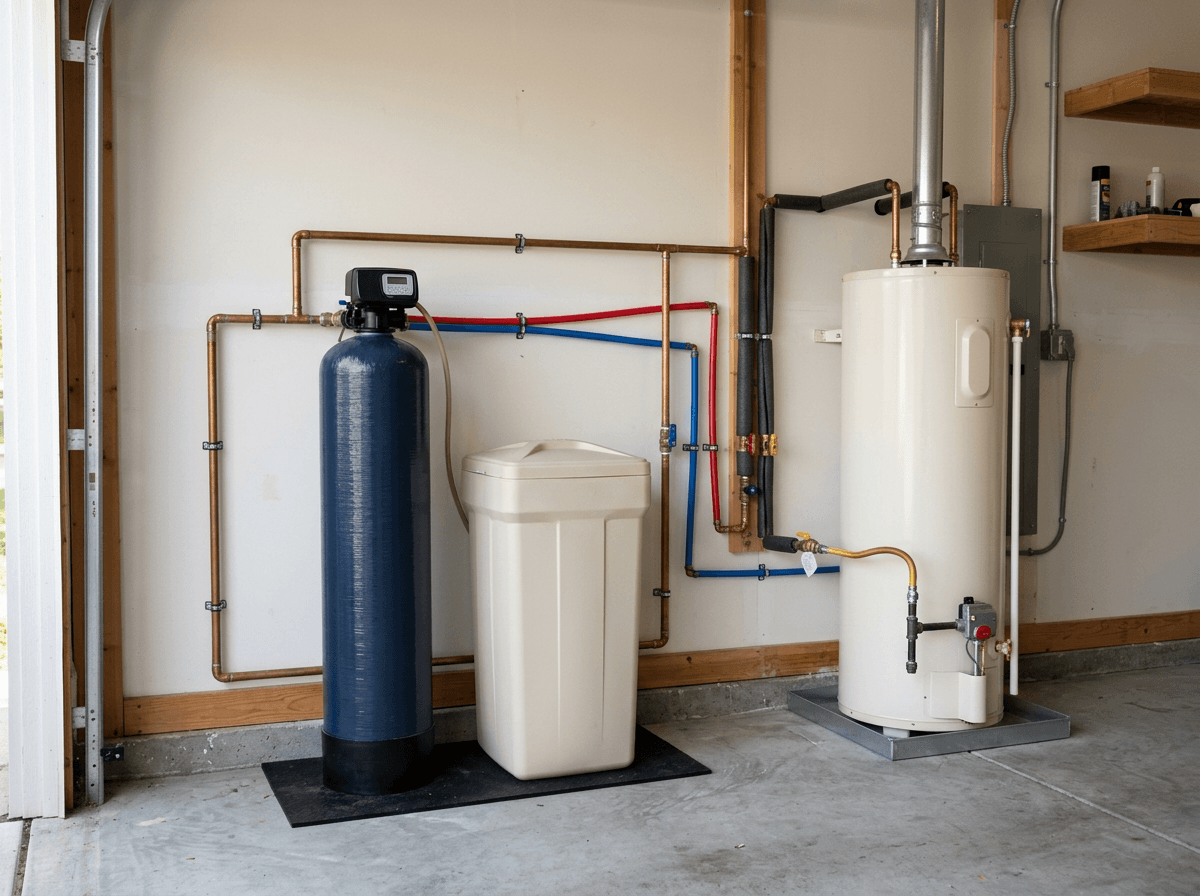
A water softener loop is a plumbing connection designed to make installing a water treatment system easier. These connections are commonly found in garages or utility areas of some newer Texas homes.
When a suitable loop is already installed, the contractor may be able to connect the water softener without significantly modifying your plumbing. This generally means less labor and a lower installation cost. However, the installer must still verify the location, water flow, drain connection, and equipment requirements.
Homes without a water softener loop
Older homes and properties that weren’t designed for water treatment equipment may require additional work. Installing a new loop can add approximately $400 to $1,200 in some straightforward Texas installations, according to published Austin-area contractor pricing. Difficult pipe routing, inaccessible plumbing, or other complications can increase that amount.
Before accepting an estimate, ask whether the quoted installation price includes all required plumbing connections.
Example: what a $3,300 installation might look like
Consider a Texas homeowner purchasing a standard water softener for a house without a pre-installed loop.
| Expense | Example cost |
|---|---|
| Water softener equipment | $1,750 |
| Installation labor | $650 |
| Fittings and connections | $200 |
| New plumbing loop | $700 |
| Total | $3,300 |
This example is illustrative, not an actual customer quote. It shows why two homeowners buying similar water softeners can receive very different installation prices.
What Affects Water Softener Installation Cost in Texas?
Several factors determine how much you’ll pay for a new system.
1. Your home’s water hardness
Water hardness measures the concentration of dissolved minerals, primarily calcium and magnesium. The harder your water, the more work your softener must perform. Homes with higher hardness levels may require equipment with greater treatment capacity or more frequent regeneration cycles.
According to the U.S. Geological Survey, water hardness is commonly classified as:
| Hardness level | Grains per gallon (approx.) |
|---|---|
| Soft | 0–3.5 |
| Moderately hard | 3.6–7.0 |
| Hard | 7.1–10.5 |
| Very hard | Above 10.5 |
Many parts of Texas experience hard water, although conditions vary substantially between cities, water providers, and individual wells. A home in San Antonio may have different treatment needs than a property in Houston or Waco.
Test your water before choosing a system. That way, you’re selecting equipment based on actual conditions rather than a sales recommendation alone.
2. Household size and daily water usage
A household with two people typically needs less treatment capacity than a household with six. Water softeners are rated in grains of hardness removal capacity — for example, you may encounter systems advertised at 32,000, 48,000, or 64,000 grains.
But the largest system isn’t automatically the best. Proper sizing considers your home’s water usage, measured hardness, flow demand, and how efficiently the equipment regenerates. Oversized systems can waste money upfront, while undersized equipment may regenerate too frequently.
3. Water softener brand and equipment quality
Not all water softeners use the same valves, resin, controls, or warranties. Budget systems can reduce upfront costs, but it’s important to compare the equipment itself.
Higher-priced systems may offer demand-initiated regeneration, improved water and salt efficiency, better serviceability, or longer warranty coverage. A higher price does not automatically guarantee better performance. Ask what makes a recommended system different and whether replacement parts are readily available.
4. Plumbing accessibility
A water softener installed beside accessible plumbing in a garage will generally cost less to install than one requiring extensive pipe routing. Additional costs can arise when the installation requires a new drain connection, electrical work, a difficult-to-access water line, or modifications to accommodate the equipment.
5. Additional water treatment equipment
A water softener addresses hardness minerals. It is not a replacement for every type of water filtration. If testing identifies additional concerns, your home may benefit from equipment such as a sediment filter, whole-home activated carbon filtration, or a reverse osmosis drinking-water system. These systems address different treatment needs and can increase the total project cost. Not sure which one your home needs? Compare a water softener vs. water filter.
Why Is Hard Water Such a Common Problem in Texas?
Texas has substantial areas with mineral-rich groundwater and limestone geology, which can contribute to elevated water hardness. As water moves through rock and soil, it can dissolve calcium and magnesium before reaching your home’s plumbing. Those minerals can create familiar problems:
- White mineral deposits on faucets and shower glass
- Scale buildup in water heaters and plumbing fixtures
- Soap scum in showers and bathtubs
- Laundry that feels stiff after washing
- Reduced soap and detergent performance
Hard water is not automatically unsafe to drink. The concern for most homeowners is the effect of scale and mineral deposits on everyday household use.
Water conditions can also change depending on whether your home receives municipal water or uses a private well. That’s why a water hardness test is more useful than relying on a general statement about your city’s water quality.
Salt-Based vs. Salt-Free: Which System Is Worth the Cost?
When comparing prices, it’s important to understand that salt-based water softeners and salt-free conditioners do different things.
Traditional salt-based water softeners
Salt-based softeners use a process called ion exchange. Water passes through a resin tank that removes calcium and magnesium ions, replacing them with sodium or potassium ions. The system periodically regenerates to restore the resin’s ability to remove hardness.
This technology is an established choice for homeowners who want to reduce actual water hardness throughout the house. For a Texas home with significant mineral buildup, a properly sized salt-based softener is often the strongest starting point.
Salt-free water conditioners
Salt-free conditioners generally leave calcium and magnesium in the water. Some use technology designed to make minerals less likely to form stubborn scale deposits. They may be useful in certain situations, particularly when avoiding salt or regeneration wastewater is a priority.
However, they do not provide the same hardness reduction as an ion-exchange water softener. If your main concern is soap performance, mineral hardness, or achieving genuinely soft water, don’t assume a salt-free conditioner will produce identical results.
How Much Does a Water Softener Cost to Maintain?
Installation isn’t the only expense to consider. Traditional water softeners require occasional salt refills and periodic maintenance.
Published homeowner cost guides estimate annual softener salt expenses at approximately $50 to $150, although households with very hard water or high consumption may spend more. Other potential expenses include replacement components, periodic servicing, and the additional water used during regeneration.
High-efficiency systems with demand-initiated regeneration can help reduce unnecessary salt and water consumption compared with less efficient configurations. When comparing equipment, consider total ownership cost rather than just the purchase price.
Is Installing a Water Softener Worth It in Texas?
For homeowners experiencing noticeable hard water problems, a properly selected water softener can be a worthwhile investment. The biggest benefit is reducing the minerals responsible for scale formation. Over time, this may help limit mineral buildup in water heaters, faucets, and other water-using equipment. Soft water can also improve soap lathering and reduce the effort needed to remove mineral deposits from household surfaces.
However, savings are not guaranteed. Your return depends on how hard your water is, the condition of your existing appliances, maintenance expenses, and the system’s installed cost.
For homes with only mildly hard water and few noticeable problems, an expensive whole-home treatment system may not be necessary. A reputable water treatment professional should be willing to explain when a smaller system — or no softener at all — makes more sense.
Do You Need a Licensed Professional to Install a Water Softener in Texas?
Texas regulates certain water treatment installation work. The Texas Commission on Environmental Quality generally requires individuals performing covered water treatment work under contract to hold an appropriate Water Treatment Specialist license, unless an exemption applies.
A Class II Water Treatment Specialist may perform qualifying water treatment installations. Licensed plumbers are among those exempted from the separate TCEQ water treatment specialist licensing requirement. Additional plumbing work and local permitting rules may involve separate requirements.
Before scheduling installation, confirm that the person performing the work has the appropriate credentials and that any required local permits will be handled. You can review the state’s requirements through the Texas Commission on Environmental Quality.
How to Avoid Overpaying for a Water Softener
The best way to avoid spending too much is to understand your water and your home’s plumbing before choosing equipment. Start by getting an actual hardness reading. Then compare written quotes based on the same treatment requirements.
Make sure each estimate explains:
- The equipment model and grain capacity
- The installation scope
- Warranty coverage
- Recurring maintenance requirements
- Whether the drain connection, bypass valve, plumbing work, and permits are included
Be cautious about purchasing a larger system simply because it’s described as more powerful. A transparent quote makes it much easier to compare the true cost of different options.
Frequently Asked Questions
How much does it cost to install a water softener in a 2,000-square-foot house?
For a typical 2,000-square-foot Texas home, a standard whole-house water softener may fall within the $1,200 to $3,800 installed planning range.
Square footage alone doesn’t determine the price. Household size, water consumption, hardness, plumbing configuration, and equipment capacity are more important.
Does a water softener increase your water bill?
A traditional salt-based softener uses water during its regeneration process, so it can increase household water consumption.
The amount depends on the system’s efficiency, programming, and how frequently it regenerates. A properly sized, demand-initiated system can help minimize unnecessary regeneration.
How long does water softener installation take?
A straightforward installation with an existing plumbing loop may be completed within several hours.
Projects requiring new plumbing, difficult drain routing, or additional treatment equipment can take longer. Your installer should explain the expected scope and schedule before work begins.
Can I install a water softener myself in Texas?
While some homeowners may be capable of connecting a system to prepared plumbing, Texas water treatment licensing rules and local permitting requirements need to be considered.
Professional installation also helps ensure the softener is properly connected, programmed, and tested.
How long does a water softener last?
A quality water softener may operate for 10 to 15 years or longer with appropriate maintenance, depending on water chemistry, equipment quality, and usage.
Individual components may need servicing or replacement during that time.
Should I get my water tested before buying a softener?
Yes. Water testing helps determine whether a softener is needed and what capacity is appropriate.
It can also identify whether your concerns involve hardness or a different water quality issue that requires another type of treatment.
Pricing note: The cost ranges in this article are planning estimates drawn from published homeowner cost guides and Texas contractor pricing available in 2026. They are not guaranteed installation prices. Equipment, local labor, permitting, and property conditions can materially change an estimate.