Comparison guide · Texas
Reverse Osmosis vs. Whole-House Filtration: Which Is Better?
Reverse osmosis is generally better for reducing a broad range of dissolved contaminants in drinking water. Whole-house filtration is often better for sediment, chlorine taste and odor, or other concerns throughout the home.
Updated 14 min read
Quick answer · RO vs. whole-house
Reverse osmosis
Broad dissolved-contaminant reduction at one faucet
Whole-house
Targeted treatment for every fixture and appliance
$300–$5,400
Typical installed range across both
The right choice depends on what’s in your water, where you need treatment, and how much you want to spend.
Here’s an important distinction: reverse osmosis is actually a type of water filtration. When homeowners compare reverse osmosis vs. water filtration, they’re usually comparing an under-sink reverse osmosis system with a whole-house sediment or carbon filtration system.
These systems solve different problems. A reverse osmosis system can reduce many dissolved substances that ordinary sediment or carbon filters don’t remove. A whole-house filtration system treats water before it reaches your showers, faucets, and appliances. Some homes benefit from both systems. Others may need only one.
Reverse Osmosis vs. Whole-House Water Filtration: Quick Comparison
Both technologies can improve water quality, but their capabilities vary significantly.
| Feature | Reverse osmosis (RO) | Whole-house filtration |
|---|---|---|
| Primary purpose | Reduce dissolved contaminants and other substances | Treat specific concerns throughout the home |
| Typical installation | Under kitchen sink | Main water supply |
| Treats drinking water | Yes | Yes, depending on filter |
| Treats shower and laundry water | Not with a typical under-sink unit | Yes |
| Reduces dissolved salts | Yes | Not with standard carbon or sediment filters |
| Reduces chlorine taste | Usually, with carbon stages | Yes, with appropriate carbon filtration |
| Removes sediment | Typically uses prefiltration | Yes, with sediment filters |
| Reduces lead | With a system certified for lead reduction | Only with appropriate certified filtration |
| Requires wastewater drainage | Yes | Not for most passive filters |
| Typical installed cost | $300–$950 under-sink | $850–$5,400 |
Costs are national planning estimates. Actual treatment performance depends on the system, its certified contaminant-reduction claims, and maintenance.
The main difference: A typical reverse osmosis system provides more extensive treatment at a specific drinking-water faucet. A typical whole-house filtration system provides targeted treatment to water used throughout the home. Neither approach is automatically better for every household.
What Is Reverse Osmosis Water Filtration?
Reverse osmosis, commonly called RO, is a water treatment process that uses pressure to force water through a semipermeable membrane. The membrane allows water to pass while rejecting many dissolved substances. The system separates incoming water into two streams:
- Treated water: Water that passes through the membrane and is collected for use.
- Reject water: Water carrying the concentrated substances that didn’t pass through the membrane.
Most residential reverse osmosis systems also include sediment and carbon filters before or after the membrane. These additional filters help protect the membrane and improve overall treatment performance.
What does reverse osmosis remove?
According to the CDC, reverse osmosis can remove or reduce a wide range of substances, including certain dissolved salts, metals, and microorganisms. Depending on the equipment, treatment can address substances such as:
- Lead and copper
- Dissolved sodium and chloride
- Certain forms of arsenic
- Fluoride
- Nitrate
- Calcium and magnesium
- Other contaminants covered by the system’s certified performance claims
Some reverse osmosis products are also certified to reduce particular PFAS chemicals. However, not every reverse osmosis system is certified to remove every contaminant on this list. Performance depends on the membrane, additional filtration stages, incoming water conditions, and the system’s specific testing and certification. Always verify the contaminant-reduction claims for the exact model you’re considering.
Where is a reverse osmosis system installed?
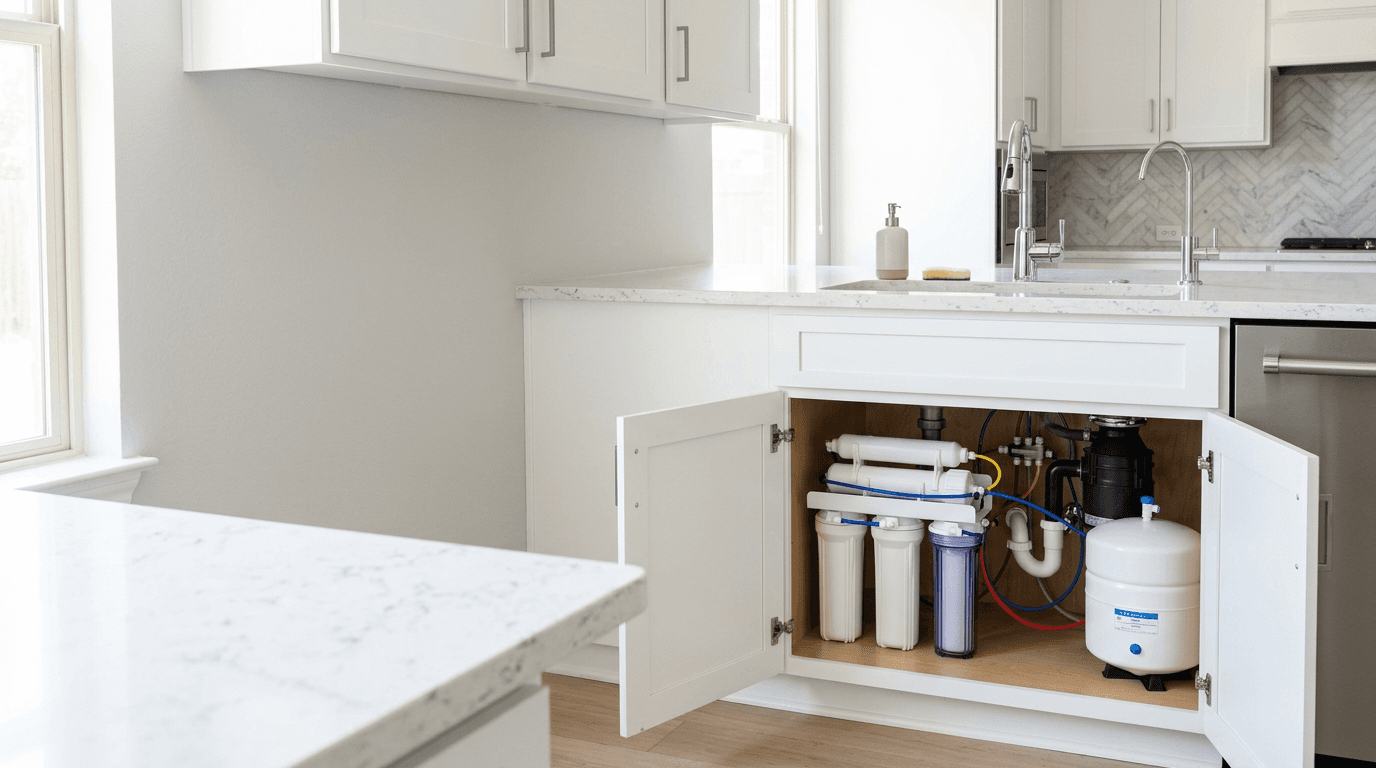
Most residential RO systems are installed beneath a kitchen sink. They typically connect to the cold-water line and provide treated water through a dedicated faucet. Some systems can also supply a refrigerator or ice maker when properly designed and installed. This is called point-of-use treatment because water is treated where it’s needed.
A kitchen RO system doesn’t ordinarily treat water going to showers, washing machines, or other fixtures. That’s one of the most important differences between a typical RO system and whole-house filtration. Learn more about our reverse osmosis installation.
What Is a Whole-House Water Filtration System?
A whole-house water filtration system treats water as it enters your home’s plumbing. It’s sometimes called a point-of-entry filtration system. Because it’s connected near the main water supply, the equipment can treat water used by multiple fixtures and appliances. See how to choose the best whole-house water filtration system.
But unlike reverse osmosis, whole-house filtration doesn’t describe one specific treatment technology. Different systems use different filters depending on the substances they are designed to reduce.
Sediment filtration
Sediment filters capture particles such as sand, rust, silt, and other suspended material. They can help improve water clarity and protect downstream treatment equipment. However, conventional sediment filtration doesn’t remove dissolved salts, hardness minerals, or most dissolved chemicals.
Activated carbon filtration
Activated carbon is commonly used to reduce chlorine taste and odor. It may also reduce certain organic chemicals or other substances when the system is specifically designed and certified for those applications. Large carbon media tanks are common in whole-house filtration configurations. However, carbon filtration isn’t a universal solution for every drinking-water contaminant.
Multi-stage filtration
Some whole-house systems combine multiple treatment technologies. For example, a configuration might include sediment filtration, activated carbon, and ultraviolet treatment. Other systems may incorporate water softening, specialized contaminant-removal media, or additional pretreatment.
Each stage should serve a specific purpose based on the home’s actual water quality. Adding more filters doesn’t necessarily mean the system will produce safer or better water.
What doesn’t a standard whole-house filter remove?
A conventional sediment and carbon system generally won’t provide the same dissolved-solids reduction as reverse osmosis. For example, ordinary carbon filtration doesn’t reliably remove dissolved sodium or fluoride. It also doesn’t remove calcium and magnesium hardness in the way a traditional water softener does.
If your primary concern involves dissolved contaminants, you may need a specialized filtration technology or reverse osmosis rather than a basic whole-house carbon filter.
Which Is Better for Drinking Water: Reverse Osmosis or Filtration?
If your primary goal is improving drinking water, reverse osmosis may provide broader treatment capabilities than a basic carbon filter. However, broader treatment isn’t always necessary.
Suppose your municipal water meets applicable drinking-water standards, but you dislike its chlorine taste. A properly selected carbon filter may address that concern without requiring reverse osmosis. Now imagine testing identifies a dissolved substance that a conventional carbon filter isn’t designed to reduce. A reverse osmosis system with an appropriate certified reduction claim may be the better choice.
The CDC recommends selecting treatment equipment based on the specific chemicals or germs present in your water.
Is reverse osmosis water healthier?
Not automatically. Reverse osmosis can reduce many substances that homeowners may want removed from drinking water. But water that already meets drinking-water standards doesn’t necessarily become healthier simply because more dissolved minerals are removed.
RO also reduces naturally occurring calcium and magnesium. While people obtain these minerals primarily through their diets, some homeowners prefer the taste of water with more mineral content. Certain RO systems include a remineralization stage to adjust the taste of the treated water.
The most important factor isn’t how many filtration stages a system has. It’s whether the system addresses a real water quality concern.
Which Is Better for Showers, Laundry, and Appliances?
Whole-house filtration is generally more appropriate when the treatment need extends beyond drinking and cooking water. For example, if a homeowner wants to reduce suspended sediment entering several fixtures, whole-house sediment filtration may make sense.
If a specific chemical presents a concern through bathing or inhalation as well as ingestion, point-of-entry treatment may also be appropriate. However, the required technology depends on the substance and how exposure occurs. A standard whole-house carbon filter shouldn’t automatically be assumed to solve every water quality problem.
Does reverse osmosis protect household appliances?
A typical under-sink RO system does not treat the water supplied to your water heater, washing machine, or showers. It generally protects only the fixtures connected to its treated-water outlet. Whole-house filtration can address certain particles or substances before they reach multiple appliances.
However, if your main problem is calcium scale from hard water, a traditional water softener may be more appropriate than either a basic carbon filter or an under-sink RO system. For more information, read our guide to Water Softener vs. Water Filter: Which Does Your Home Need?
Which System Removes More Contaminants?
It depends on which contaminants you’re measuring. Reverse osmosis generally has broader capabilities for reducing many dissolved substances than ordinary sediment or carbon filtration. But some specialized whole-house filters are designed for contaminants that standard RO systems may not adequately address without additional treatment.
Rather than claiming one produces “purer” water, here’s what each typically handles — and the certification that confirms it for a specific model.
What each is certified to remove
Under-sink RO vs. a standard whole-house sediment and carbon system — and the certification to look for on the exact model.
Chlorine taste & odor
Look for: NSF/ANSI 42
Sand & sediment
Look for: Sediment prefilter rating
Total dissolved solids
Look for: NSF/ANSI 58
Dissolved sodium & chloride
Look for: NSF/ANSI 58
Lead
Look for: NSF/ANSI 53 or 58 lead claim
Fluoride
Look for: NSF/ANSI 58 fluoride claim
Nitrate
Look for: NSF/ANSI 58 nitrate claim
Certain PFAS
Look for: NSF/ANSI 53 or 58 PFAS claim
Hardness (whole home)
Look for: NSF/ANSI 44 water softener
Microorganisms
Look for: Disinfection, e.g. NSF/ANSI 55 UV
Shows typical product categories, not any specific model. A standard certification doesn’t guarantee every claim — NSF/ANSI 58 requires TDS reduction, while lead, fluoride, nitrate, and PFAS claims are optional. Verify the exact certified claims before buying.
Match the concern to the treatment
| Water quality concern | Treatment to investigate |
|---|---|
| Chlorine taste and odor | Certified carbon filtration |
| Visible sand or sediment | Sediment filtration |
| Dissolved sodium or chloride | Reverse osmosis |
| Lead in drinking water | RO or filtration certified for lead reduction |
| Certain PFAS chemicals | RO or specialized filtration with verified claims |
| Dissolved fluoride | Appropriately certified RO or other specialized treatment |
| Calcium and magnesium hardness | Ion-exchange water softener |
| Microorganisms | Appropriate disinfection or validated treatment |
| Multiple water quality concerns | Testing-based combination of technologies |
This chart isn’t a substitute for water testing.
For example, a filter advertised as a carbon filter may be certified for chlorine taste and odor without being certified for lead or PFAS reduction. The same principle applies to reverse osmosis equipment. Always match the specific product’s verified capabilities to the substances that actually need treatment.
Reverse Osmosis vs. Whole-House Filtration Cost
Installation cost is a major consideration for homeowners comparing the two options. According to published national pricing guides, an under-sink reverse osmosis system typically costs between $300 and $950 installed. Whole-house filtration generally costs between $850 and $5,400 installed. Specialized equipment can exceed these ranges.
| System | Estimated installed cost |
|---|---|
| Basic under-sink filtration | $170–$580 |
| Under-sink reverse osmosis | $300–$950 |
| Whole-house sediment and carbon filtration | $850–$1,400 |
| Multi-stage whole-house filtration with UV | $1,850–$2,900 |
| Advanced whole-house filtration combinations | $2,650–$5,400 |
| Whole-house reverse osmosis | $4,800–$8,000+ |
These are general U.S. budgeting estimates from published homeowner cost guides, not guaranteed Clearly Water Systems or Texas installation prices. Complex whole-house RO projects can cost considerably more.
Why is whole-house filtration usually more expensive?
The main reason is capacity. An under-sink system produces relatively small volumes of treated water for drinking and cooking. A whole-house system must support much higher flow rates to serve showers, appliances, and multiple faucets. That often requires larger equipment, more filtration media, and more substantial plumbing connections.
What affects installation cost?
- Equipment capacity and filtration technology
- Plumbing accessibility
- Existing treatment equipment
- Required drain or electrical connections
- Water pressure and flow requirements
- Specialized pretreatment
- Local labor and permit requirements
For more detailed pricing, read our guide to Whole-House Water Filtration System Cost: What Homeowners Should Expect.
Does Reverse Osmosis Waste More Water?
Yes. Reverse osmosis generally produces reject water as part of its treatment process. This is one of the most important tradeoffs when considering RO.
The EPA reports that a typical point-of-use reverse osmosis system may discharge five gallons or more of reject water for every gallon of treated water produced. Some inefficient models discharge even more. However, newer efficient systems can perform substantially better.
Reject water per gallon of treated water
Based on EPA WaterSense figures.
Typical point-of-use RO
5+ gallons
EPA estimate for a typical system; inefficient models discharge more.
WaterSense-labeled RO
≤ 2.3 gallons
Maximum allowed under the EPA WaterSense specification (November 2024).
Passive sediment & carbon filter
No reject stream
Most passive filters don’t discharge water continuously; some backwashing systems do.
What is a WaterSense-certified RO system?
The EPA established its WaterSense specification for point-of-use reverse osmosis systems in November 2024. To earn the WaterSense label, a qualifying RO system must discharge no more than 2.3 gallons of reject water for each gallon of treated water, along with meeting the program’s other efficiency and performance requirements.
That makes water efficiency an important purchasing consideration. When comparing RO equipment, ask about its water efficiency, reject-water ratio, and WaterSense certification.
Do whole-house filters waste water?
Many passive sediment and carbon filters don’t produce a continuous reject-water stream. However, some whole-house treatment systems use water for backwashing or other maintenance processes. Water consumption depends on the technology. Don’t assume that every whole-house filtration system operates without wastewater or that every RO system has the same efficiency.
Which System Is Easier to Maintain?
Both reverse osmosis and whole-house filtration require maintenance. The difference is what needs to be serviced and how often.
Reverse osmosis maintenance
Most RO systems use several components that require periodic replacement. These may include sediment prefilters, carbon filters, the RO membrane, and post-treatment filters. Depending on the system and water conditions, prefilters may need replacement every 6 to 12 months, while membranes may last several years. Actual schedules vary by manufacturer and incoming water quality. Some systems also need periodic sanitization or storage-tank maintenance.
Whole-house filtration maintenance
Maintenance depends on the equipment. Sediment cartridges may require relatively frequent replacement, particularly when incoming water contains significant debris. Large carbon media tanks often have longer service intervals. Some multi-stage systems also require additional components such as UV lamps or specialized treatment media.
The best way to compare maintenance is to request the expected replacement schedule and parts cost for each specific system.
Which costs less over time?
Neither option is universally cheaper. An under-sink RO system treats less water but requires membrane-related maintenance and produces reject water. A whole-house filtration system may have larger replacement filters or media, but some passive configurations have relatively low ongoing operating expenses. Compare the total cost over several years rather than focusing only on equipment price.
Can You Install Reverse Osmosis for Your Entire House?
Yes. Whole-house reverse osmosis systems exist, although they’re less common in ordinary residential installations. These systems use the same basic membrane separation process as under-sink RO, but on a substantially larger scale. A whole-house RO installation may require:
- High-capacity membrane equipment
- Pretreatment to protect the membranes
- Treated-water storage tanks
- Pumps and pressure controls
- Appropriate wastewater drainage
- Post-treatment or remineralization where needed
These requirements make whole-house RO considerably more expensive and complex than a typical kitchen system. It may be appropriate for certain properties with challenging water chemistry or specialized treatment needs.
However, many homeowners don’t need reverse osmosis treatment for every gallon of water they use. Treating drinking water at the kitchen sink while using a targeted whole-house system for other concerns may provide a more practical balance.
Do You Need Both Reverse Osmosis and Whole-House Filtration?
Some homeowners do benefit from combining both technologies. For example, consider a home where the incoming water contains sediment and where the homeowner also wants additional treatment of drinking water for specific dissolved contaminants. A whole-house sediment filter can reduce particles entering the home’s plumbing. An under-sink reverse osmosis system can provide more specialized treatment at the kitchen faucet.
Another possible configuration includes whole-house water softening for hardness and under-sink RO for drinking-water treatment — see water softener and filtration combos. But adding equipment without a specific purpose can create unnecessary expense.
Example: Choosing treatment based on the problem
| Home | Starting point |
|---|---|
| A: Municipal water with unpleasant chlorine taste | Appropriately certified carbon filter; whole-house RO would likely be excessive |
| B: Very hard water with mineral buildup | Traditional water softener; under-sink RO wouldn’t address hardness in the plumbing |
| C: Drinking water with a confirmed dissolved contaminant | RO certified for that contaminant, possibly limited to drinking and cooking water |
| D: Private well with multiple water quality problems | Test-driven combination — sediment, softening, disinfection, specialized filtration, or RO |
The equipment should be selected for the actual test results rather than purchased as a generic all-in-one package. Well owners can start with what to test in Texas well water.
What Should Texas Homeowners Consider?
Water treatment needs can vary significantly across Texas. Homes in Waco, Dallas, Austin, Houston, San Antonio, and surrounding communities may receive water from different municipal sources or private wells. Those differences affect which treatment technology makes sense. See where we install on our service areas page.
If you have municipal water
Start by reviewing your water utility’s Consumer Confidence Report. This annual report provides information about the water supplied by your public utility, including regulated contaminants. If your primary complaint is chlorine taste or odor, you may not need an extensive RO system. If you’re concerned about a specific contaminant, identify it and verify whether the equipment you’re considering is certified to reduce it.
A whole-house carbon filter that removes chlorine also removes some of the disinfectant residual that helps control microbial growth within plumbing. The CDC cautions that eliminating this residual can allow more germs to grow in downstream household plumbing. Whole-house dechlorination should be a considered treatment decision, not an automatic upgrade.
If you have private well water
Private well owners are responsible for monitoring their own water quality. The CDC recommends testing private well water at least annually for total coliform bacteria, nitrates, total dissolved solids, and pH, with additional testing based on local conditions. If results identify contaminants of concern, the treatment strategy should be tailored to those findings.
A conventional carbon filter cannot be assumed to make contaminated well water safe to drink. Likewise, an RO system should not replace the need to identify and properly address microbiological contamination. Professional laboratory testing is especially important when water safety is a concern.
How to Choose Between Reverse Osmosis and Whole-House Filtration
If you’re still unsure, use these four questions to narrow down the decision.
1. What exactly are you trying to remove?
Start with water testing, utility reports, or a clearly identified household problem. Chlorine taste and odor may call for carbon filtration. Dissolved substances may require RO or another specialized technology. Visible sediment may call for a sediment filter. Hard water usually requires a different approach — start with testing your water hardness.
2. Where do you need treatment?
If you only need additional treatment for water used in drinking and cooking, a point-of-use system may be sufficient. If the concern affects showers, laundry, or multiple fixtures, whole-house treatment may be appropriate. The correct location depends on the substance and the ways household members may be exposed to it.
3. What is the equipment certified to remove?
Independent testing and certification help verify performance claims. Important standards include:
| Standard | General purpose |
|---|---|
| NSF/ANSI 42 | Aesthetic claims such as chlorine taste and odor |
| NSF/ANSI 53 | Specific contaminants with health effects |
| NSF/ANSI 58 | Reverse osmosis drinking-water systems |
| NSF/ANSI 401 | Certain emerging contaminant reduction claims |
| NSF/ANSI 55 | Ultraviolet microbiological treatment |
NSF/ANSI 58 includes requirements for RO system performance, including total dissolved solids reduction. Other contaminant-reduction claims under that standard may be optional. That means a system certified to NSF/ANSI 58 shouldn’t automatically be assumed to reduce every possible contaminant. Verify the exact certified claims for the specific model.
4. What will it cost to own and maintain?
Look at more than the initial installation price. Ask about replacement filters, membrane life, media replacement, water consumption, and service requirements. If you’re considering RO, compare water efficiency as well. If you’re considering whole-house filtration, verify the equipment’s flow capacity and expected maintenance schedule.
A system that properly addresses your problem with less equipment and lower maintenance costs may be the better investment.
Frequently Asked Questions
Is reverse osmosis better than regular water filtration?
Reverse osmosis generally removes a broader range of dissolved substances than basic sediment or carbon filtration. However, it isn’t automatically better for every water quality problem.
If your goal is simply reducing chlorine taste, an appropriate carbon filter may be sufficient.
Does reverse osmosis remove more contaminants than carbon filters?
Reverse osmosis can reduce dissolved substances that conventional carbon filters generally do not remove, including many salts and certain metals. However, some specialized carbon filters are certified for particular contaminants.
Always compare exact performance claims.
Is reverse osmosis water safe to drink?
Water from a properly selected, installed, and maintained RO system can be suitable for drinking when the system is appropriate for the source water. However, RO isn’t a guarantee of safety under every condition.
If your source water contains harmful contaminants, select a system with appropriate verified performance and use follow-up testing when necessary.
Can I use reverse osmosis instead of a water softener?
An RO system can reduce calcium and magnesium in the water it treats. However, an ordinary under-sink RO system doesn’t soften water throughout your home.
If you’re dealing with hardness-related scale in showers, water heaters, and appliances, a whole-house water softener may be more practical.
Does whole-house filtration remove fluoride?
Standard sediment and activated carbon filters generally don’t provide reliable fluoride reduction. Reverse osmosis and certain specialized treatment technologies can reduce fluoride when properly selected.
Verify the system’s certified performance claims.
Does reverse osmosis remove chlorine?
Most residential RO systems include carbon filtration stages that reduce chlorine. This is also important because chlorine exposure can damage certain RO membranes.
Check the equipment’s specifications and certification for chlorine-reduction claims.
Do I need whole-house filtration if I already have reverse osmosis?
Not necessarily. If your RO system addresses your drinking-water concerns and there are no additional treatment needs elsewhere in the home, whole-house filtration may be unnecessary.
If you have sediment, hardness, or another concern affecting multiple fixtures, additional treatment may make sense.
Is whole-house reverse osmosis worth it?
Whole-house RO can be worthwhile for certain challenging water conditions, but it’s usually more expensive and complex than point-of-use treatment.
For many residential applications, treating only drinking and cooking water with RO provides a more economical approach.
How long do reverse osmosis filters last?
Replacement schedules vary by model, water chemistry, and usage. Some prefilters require replacement every 6 to 12 months, while RO membranes may last several years.
Follow the manufacturer’s instructions and monitor performance as recommended.
The Bottom Line: Reverse Osmosis or Whole-House Filtration?
Reverse osmosis and whole-house filtration are both useful technologies, but they address different treatment needs.
- Choose reverse osmosis when you want targeted drinking-water treatment for dissolved substances that a properly certified RO system can reduce.
- Choose whole-house filtration when you have a specific water quality concern that needs treatment at multiple fixtures throughout the home.
- Consider both when testing identifies separate treatment needs that are best addressed through different technologies.
And if your water is already suitable for your household and you aren’t experiencing a problem, additional filtration may not be necessary. The smartest approach is to identify what needs treatment first, then choose equipment with verified performance for that specific purpose.
Find the Right Water Filtration System With Clearly Water Systems
Not sure whether your home needs reverse osmosis, whole-house filtration, or a combination of both? Clearly Water Systems helps homeowners explore water treatment options based on their water conditions, household needs, and treatment goals.
You don’t need to purchase the most expensive equipment to make a good decision. You need the right equipment for the problem you’re trying to solve.
Last reviewed: November 2026. Installation pricing represents national budgeting estimates, not guaranteed Clearly Water Systems rates. Proper treatment selection requires evaluating source water conditions, equipment performance, and applicable installation requirements.
Sources and further reading
- CDC — About Home Water Treatment Systems
- CDC — About Choosing Home Water Filters
- EPA — Point-of-Use Reverse Osmosis Systems
- EPA — Overview of Drinking Water Treatment Technologies
- NSF — NSF/ANSI 58 Reverse Osmosis Drinking Water Treatment Systems
- NSF — Standards for Water Treatment Systems
- HomeGuide — Home Water Filtration System Cost
- HomeGuide — Reverse Osmosis System Cost
- CDC — Guidelines for Testing Well Water