Testing guide · Texas
How to Test Water Hardness at Home: Understanding GPG and PPM
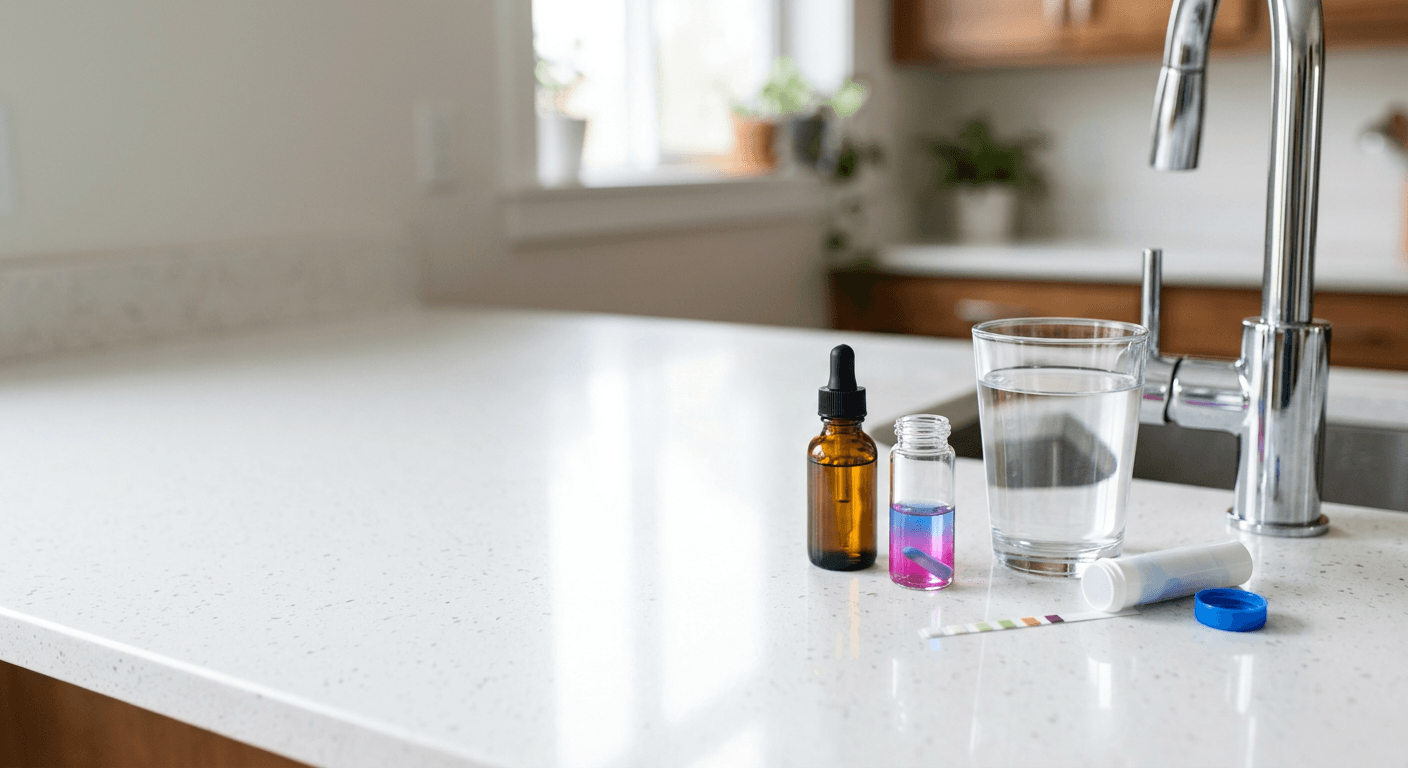
The easiest way to test water hardness at home is with a test strip or a liquid drop kit. Both show how much calcium and magnesium is in your water, usually in grains per gallon (GPG) or parts per million (PPM).
Updated 13 min read
Quick answer · Three ways to test
Test strips
Fastest screening — a broad range in seconds
Drop kits
More precise — useful for softener sizing
Lab testing
Most precise — plus other water quality checks
Testing takes only a few minutes with most home kits, and the results can help explain problems like white mineral buildup on faucets, cloudy dishes, stubborn soap scum, and scale inside appliances.
But understanding the numbers is just as important as performing the test. Is 150 PPM considered hard water? What does 10 GPG mean? And at what level should you consider installing a water softener? Already have a result? Jump to the converter.
How to Test Water Hardness at Home: Quick Answer
There are three practical ways to determine your home’s water hardness:
- Water hardness test strips: Dip a strip into a water sample and compare the resulting color with the manufacturer’s chart.
- Liquid drop test kits: Add testing reagents to a measured water sample until the solution changes color. Use the result to calculate hardness.
- Professional water testing: Submit a sample to a qualified laboratory when you need more precise results or testing for additional water quality concerns.
You may also be able to obtain hardness information directly from your municipal water utility. For a quick household screening, test strips are convenient. For a more precise reading to help size or program a water softener, a good drop-based hardness test is often more useful.
What Is Water Hardness?
Water hardness describes the amount of dissolved calcium and magnesium in water. As water travels through rock and soil, it can dissolve naturally occurring minerals. Those minerals eventually make their way into groundwater, public water supplies, and household plumbing.
Hardness is not generally a drinking-water health concern by itself. However, it can contribute to several common household problems — see the full list in 7 Signs You Have Hard Water in Your Home:
- White mineral deposits on faucets and showerheads
- Cloudy spots on dishes and drinking glasses
- Soap scum in showers and bathtubs
- Reduced performance of traditional soaps
- Scale accumulation inside water heaters
- Mineral buildup in plumbing fixtures
The amount of hardness determines how likely these problems are to occur and how much treatment may be beneficial. That’s why measuring water hardness is more useful than simply looking for signs of mineral buildup.
Water Hardness Chart: Understanding GPG and PPM
Water hardness is commonly measured using two units: grains per gallon (GPG) and parts per million (PPM). Both describe the same general property when the PPM measurement refers specifically to total hardness expressed as calcium carbonate. The U.S. Geological Survey classifies water hardness using the following ranges.
| Water hardness | GPG | PPM as calcium carbonate |
|---|---|---|
| Soft | 0–3.5 | 0–60 |
| Moderately hard | 3.6–7.0 | 61–120 |
| Hard | 7.1–10.5 | 121–180 |
| Very hard | Above 10.5 | Above 180 |
The GPG values are approximate conversions of the USGS hardness classifications.
GPG ↔ PPM converter and result reader
Enter your test result in whatever unit your kit uses.
The math
150 PPM ÷ 17.1 = 8.8 GPG
Grains/gal
8.8
PPM
150
USGS classification
Hard
Recurring scale, cloudy dishes, and soap problems become more noticeable. A water softener may be worth considering.
Estimate the softener size you’d needWant help deciding what to do with this result?
Request a QuoteFor example:
- 50 PPM is considered soft water.
- 100 PPM is considered moderately hard water.
- 150 PPM is considered hard water.
- 250 PPM is considered very hard water.
These classifications help homeowners interpret their results, but they aren’t mandatory treatment thresholds. A home with moderately hard water might experience few noticeable problems, while another household may decide to address recurring scale buildup.
What Does GPG Mean in Water Hardness?
GPG stands for grains per gallon. It’s a traditional unit used to describe the amount of hardness minerals in water. One grain per U.S. gallon equals approximately 17.1 milligrams of hardness, expressed as calcium carbonate, per liter of water. If your water measures 10 GPG, that means it has approximately 171 PPM of total hardness.
GPG is commonly used when selecting and programming residential water softeners. For example, you may see equipment advertised as a 32,000-grain or 48,000-grain water softener. Those capacities describe how much hardness the system is rated to remove under specified conditions before regeneration. They do not refer to the water’s hardness concentration.
A household with 20 GPG water generally places twice the daily hardness-removal demand on a softener as a household using the same amount of water at 10 GPG.
What does PPM mean in water hardness?
PPM stands for parts per million. It describes the concentration of a substance within water. For water hardness, PPM typically refers to the total calcium and magnesium hardness expressed as an equivalent amount of calcium carbonate (CaCO3).
For dilute water solutions, one PPM is approximately equal to one milligram per liter (mg/L). This is why a hardness result may appear as 150 PPM as CaCO3 or 150 mg/L as CaCO3. Both represent approximately the same hardness concentration.
An important distinction: the phrase as CaCO3 is a standardized way of expressing hardness. It doesn’t mean every dissolved hardness mineral is literally present as calcium carbonate.
Is Water Hardness PPM the Same as TDS PPM?
No. This is one of the most common mistakes homeowners make when testing their water.
Total dissolved solids (TDS) measures or estimates the total concentration of dissolved substances in water. That may include calcium, magnesium, sodium, potassium, chloride, and other dissolved ions. Water hardness, on the other hand, focuses primarily on calcium and magnesium.
A water sample with 300 PPM TDS does not necessarily contain 300 PPM hardness. Likewise, a traditional water softener may substantially reduce hardness without causing a large reduction in TDS because it exchanges calcium and magnesium for sodium or potassium.
A basic digital TDS meter is not a reliable way to measure water hardness or verify that a conventional softener is working. Use a dedicated hardness test instead.
How to Test Water Hardness With Test Strips
Water hardness test strips are one of the simplest methods for homeowners. They use chemicals that change color in response to the hardness minerals present in a water sample. Most kits provide a color chart showing different hardness ranges.
Step 1: Collect a water sample
Fill a clean container with cold tap water from the location you want to test. If you’re checking the hardness entering your home, use untreated water before any existing water softener or reverse osmosis system.
Step 2: Dip the test strip
Place the testing portion of the strip into the water for the amount of time specified by the manufacturer. Some products require only a few seconds of contact.
Step 3: Remove the strip
Follow the instructions for removing the strip and handling excess water. Avoid touching the testing pad with your fingers.
Step 4: Wait for the indicated development time
The color may continue changing after the strip leaves the water. Read it at the specific time required by the kit.
Step 5: Compare the result
Match the color to the manufacturer’s reference chart. Depending on the product, your result may be reported in PPM, GPG, or a broad category such as hard or very hard.
Are water hardness test strips accurate?
Test strips can provide a useful estimate, especially when you’re trying to determine whether your water is generally soft, moderately hard, or very hard. However, they usually offer broader measurement ranges than a properly used titration kit. Color interpretation, expired strips, improper storage, and incorrect reading times can affect the result.
If you’re buying a water softener and need a more precise hardness value for equipment sizing, consider using a drop-based test or appropriate laboratory analysis.
How to Test Water Hardness With a Liquid Drop Kit
A liquid drop hardness test, sometimes called a titration test, is another practical option. Many kits use reagents that cause a measured water sample to change color when the hardness measurement is complete. Instead of comparing shades on a strip, you count the required reagent drops or calculate a result from the amount of reagent used.
Step 1: Fill the testing vial
Add the specified volume of water to the vial included with the kit. Using the correct water volume is important because the calculation depends on it.
Step 2: Add the required reagents
Some kits use a buffer and an indicator before the titration reagent. Follow the manufacturer’s instructions for the number and order of drops.
Step 3: Add the titration reagent
Slowly add drops while mixing the sample as instructed. Count the drops until the specified color change occurs.
Step 4: Calculate the hardness
Use the kit’s conversion factor to determine hardness. For some kits, one drop equals one grain per gallon when the specified sample volume is used. Other kits use different sample volumes or conversion factors. Always follow the instructions for your particular product.
Example: Reading a drop test
Suppose your test kit specifies that each drop represents one GPG. You add the titration reagent, and the water changes to the required endpoint color after 12 drops.
12 drops × 1 GPG = 12 GPG → 12 × 17.1 = 205.2 PPM
That would place your water in the very hard category. The converter’s drop count mode does this calculation for you. A drop-based test can be especially useful when comparing untreated water with water leaving an existing water softener.
How to Convert PPM to GPG
If your water hardness test reports results in PPM but your water softener uses GPG, you can convert between the two. The conversion is simple:
GPG = PPM ÷ 17.1
For example, suppose your water test shows 200 PPM of total hardness as calcium carbonate. 200 ÷ 17.1 = 11.7 GPG, so your water hardness is approximately 11.7 grains per gallon. You can also convert from GPG back to PPM:
PPM = GPG × 17.1
Water hardness conversion chart
| PPM as calcium carbonate | Approximate GPG | Classification |
|---|---|---|
| 50 | 2.9 | Soft |
| 75 | 4.4 | Moderately hard |
| 100 | 5.8 | Moderately hard |
| 125 | 7.3 | Hard |
| 150 | 8.8 | Hard |
| 175 | 10.2 | Hard |
| 200 | 11.7 | Very hard |
| 250 | 14.6 | Very hard |
| 300 | 17.5 | Very hard |
| 400 | 23.4 | Very hard |
These conversions apply to hardness readings expressed as calcium carbonate, not general TDS readings.
Can You Test Water Hardness Without a Kit?
You can look for signs that suggest hard water, but you can’t determine an accurate GPG or PPM reading without an appropriate measurement method. One common DIY screening method is the soap-bottle test.
The soap-bottle test
Fill a clean, clear bottle about one-third full with tap water. Add a small amount of plain liquid soap, close the lid, and shake. Water that contains significant hardness may produce less lasting lather and more cloudy soap residue than soft water.
However, results depend on the type and amount of soap used. Many hand soaps and detergents contain ingredients designed to work in hard water, making the comparison less useful. The soap test is only a rough indicator. It cannot tell you how many grains per gallon your water contains.
Where Should You Collect Water for a Hardness Test?
Choosing the right testing location is important. A perfectly accurate hardness test can still give you the wrong information for your purpose if you collect water after an existing treatment system.
Testing for a new water softener
Test untreated cold water entering your home. That provides the hardness value needed for water softener sizing. If you already have treatment equipment, identify a safe, accessible sampling point before it. Do not disconnect pressurized plumbing simply to obtain a sample.
Testing an existing water softener
To determine whether your softener is reducing hardness, compare two samples:
- Untreated water before the softener
- Treated cold water after the softener
For example, untreated water might measure 15 GPG while properly softened water measures approximately 0–1 GPG. Actual performance depends on the equipment, settings, and testing conditions. If both readings are similarly high, check whether the softener is bypassed or requires service.
Avoid testing the wrong faucet
Some homes have plumbing configurations that send unsoftened water to outdoor faucets, irrigation systems, or selected indoor fixtures. Others have under-sink reverse osmosis systems that further treat drinking water. Before using a result to size or troubleshoot equipment, confirm whether the faucet supplies untreated, softened, or separately filtered water.
How often should you test your water hardness?
There isn’t one required hardness-testing schedule for every home. If you receive municipal water and your water conditions appear stable, an initial hardness test may provide a useful baseline. Consider retesting if you notice new scale buildup, changes in soap performance, or a change in the water supply. You should also check hardness after installing or adjusting a water softener.
Remember that hardness is only one aspect of water quality. For private wells, the CDC recommends testing at least annually for total coliform bacteria, nitrates, total dissolved solids, and pH, with other testing based on local risks. A hardness test does not replace those water safety tests.
What Is a Good Water Hardness Level for a Home?
There isn’t a universal hardness level that every homeowner must achieve. For household convenience, lower hardness generally means less calcium and magnesium available to form mineral scale. But hard water isn’t automatically unsafe to drink, and the decision to soften it is usually based on maintenance, cleaning performance, and personal preference.
Below 3.5 GPG: Soft water
At this level, significant hardness-related scale is generally less likely. You probably don’t need a conventional water softener solely to address hardness unless there is a specific reason.
Between 3.6 and 7 GPG: Moderately hard water
Some homeowners may notice water spots, soap residue, or occasional mineral deposits. Others may experience few problems. Treatment is usually a matter of household priorities rather than an automatic necessity.
Between 7.1 and 10.5 GPG: Hard water
Hardness-related issues may become more noticeable. Recurring scale buildup, cloudy dishes, and soap performance problems can make water softening worth considering.
Above 10.5 GPG: Very hard water
At this level, mineral buildup can be a persistent household concern. If you’re regularly cleaning scale from faucets, showerheads, or appliances, a properly sized softener may provide meaningful benefits. However, a hardness classification alone doesn’t determine the appropriate equipment.
What Should You Do if Your Water Tests Hard?
If your water test confirms significant hardness, the next step is identifying what you want to improve.
Option 1: Manage existing mineral buildup
If the problem is relatively minor, cleaning deposits and maintaining fixtures may be enough. Appropriate descaling products can remove existing buildup from compatible surfaces. This doesn’t change your water hardness, but it may be sufficient for households experiencing only occasional problems.
Option 2: Consider a salt-based water softener
A traditional salt-based water softener uses ion exchange to reduce calcium and magnesium. That makes it an established treatment option for homeowners who want to reduce actual hardness. Benefits may include less new scale formation and improved soap and detergent performance.
If you’re considering installation, start by reviewing the estimated costs and requirements in our guide, How Much Does Water Softener Installation Cost in Texas?
Option 3: Evaluate salt-free water conditioning
Some salt-free conditioners are designed to reduce certain kinds of scale formation. However, most do not remove calcium and magnesium. This means a hardness test performed after a conventional salt-free conditioner may show nearly the same hardness concentration as untreated water. To understand the difference, read Salt vs. Salt-Free Water Softeners: What’s the Difference?
Option 4: Size the equipment correctly
The correct water softener depends on more than your hardness number. Household size, daily water consumption, service flow requirements, and usable grain capacity all matter. For example, a family of four using 300 gallons of softened water per day at 15 GPG has an estimated daily hardness load of:
300 gallons × 15 GPG = 4,500 grains per day
The installer can use that information, along with the equipment’s rated performance, to select an appropriate system. For a complete walkthrough and calculator, see What Size Water Softener Do I Need?
How to Find Your Water Hardness in Texas
Water conditions vary significantly throughout Texas. Groundwater sources, local geology, municipal treatment practices, and blended water supplies can influence hardness. Some areas have naturally mineral-rich water, while others experience lower hardness levels. Even homes in the same general region may receive water from different sources. For a worked local example, see how hard Waco’s water is, San Antonio’s water hardness, or Round Rock’s water hardness.
If you live in Waco, Austin, Dallas, Houston, San Antonio, or another Texas community, begin with your actual water provider. See where we install on our service areas page.
Check your municipal water quality information
Public water systems publish annual Consumer Confidence Reports that provide information about drinking-water quality. Hardness isn’t always included in these reports, but your utility may publish it separately or provide it upon request.
For example, the City of Waco publishes water quality information that includes calcium and magnesium measurements. Those values can help explain the mineral composition of the supplied water, but a sample from your own home is more useful when making an equipment-sizing decision.
Test private well water separately
Private wells may have water chemistry that differs substantially from nearby municipal supplies. If you use well water, consider appropriate laboratory testing when purchasing treatment equipment. Iron, manganese, sediment, and other water quality concerns can influence which treatment system is appropriate. A water hardness test by itself cannot determine whether your well water is safe to drink. See Well Water Treatment in Texas: What to Test First.
Common Water Hardness Testing Mistakes to Avoid
Several simple mistakes can lead to misleading results.
- Using a TDS meter instead of a hardness test: A TDS meter estimates overall dissolved solids, not calcium and magnesium hardness specifically.
- Testing water after an existing softener: This can produce a low reading that doesn’t represent the incoming water used for equipment sizing.
- Reading test strips too early or too late: Results should be interpreted at the exact time specified by the manufacturer.
- Using expired testing chemicals: Reagents and strips can deteriorate over time or when stored incorrectly.
- Assuming PPM always means hardness: A PPM result could refer to TDS, chlorine, iron, or another substance. Check what the test measures.
- Treating a hardness test as a drinking-water safety test: Hardness results don’t tell you whether harmful microorganisms or other contaminants are present.
Getting an accurate hardness reading begins with selecting the right test, collecting the correct water sample, and following the instructions carefully.
Frequently Asked Questions About Testing Water Hardness
What is the easiest way to test water hardness at home?
A water hardness test strip is usually the simplest option. Collect a sample of cold tap water, use the strip according to the manufacturer’s instructions, and compare the result with its color chart.
For a more precise reading, consider a liquid drop hardness kit.
Can I test water hardness without buying a kit?
You can contact your water utility for available hardness data or try a basic soap-lather comparison.
However, neither a soap test nor visual signs of scale provides an exact hardness measurement for your home.
Is 100 PPM hard water?
A total hardness reading of 100 PPM as calcium carbonate is classified as moderately hard. That is approximately 5.8 GPG.
Some households may notice minor hardness symptoms at this level, but treatment isn’t automatically required.
Is 200 PPM hard water?
Yes. A hardness reading of 200 PPM is approximately 11.7 GPG and is classified as very hard.
If you’re experiencing recurring scale or soap performance problems, a water softener may be worth considering.
What does 300 PPM water hardness mean?
A hardness result of 300 PPM as calcium carbonate is approximately 17.5 GPG. That’s considered very hard water.
However, a 300 PPM reading from a general TDS meter is not the same as a 300 PPM hardness result.
What is the difference between GPG and PPM?
Both can describe water hardness. GPG means grains per gallon, while PPM means parts per million.
For total hardness expressed as calcium carbonate, one GPG equals approximately 17.1 PPM.
Can a digital TDS meter test water hardness?
No. A conventional TDS meter estimates total dissolved solids from electrical conductivity. It doesn’t distinguish calcium and magnesium from other dissolved substances.
Use a hardness-specific test for accurate hardness measurements.
What should water hardness be after a softener?
A properly functioning conventional ion-exchange softener can often produce water with very low residual hardness, commonly around 0–1 GPG under suitable operating conditions.
However, the expected result depends on equipment configuration and performance specifications. If your treated-water reading is higher than expected, check the system’s operation or have it serviced.
Does boiling water remove hardness?
Boiling can reduce some temporary hardness by causing certain dissolved minerals to precipitate. However, it doesn’t reliably remove all hardness.
Boiling is not a practical substitute for whole-house water softening.
Should I test hot or cold water?
For initial water hardness measurement and softener sizing, use untreated cold water. Hot water may be affected by the water heater and existing mineral deposits.
If you’re troubleshooting a specific hot-water problem, additional testing may be appropriate.
The Bottom Line: Test Before You Treat
Learning how to test water hardness is one of the easiest ways to make a more informed water treatment decision. Whether you use a test strip, a liquid drop kit, or laboratory testing, understanding your hardness level helps you determine whether mineral buildup is likely contributing to household problems.
Remember the two most important measurements:
GPG = PPM ÷ 17.1 · PPM = GPG × 17.1
These conversions apply when PPM represents total hardness expressed as calcium carbonate.
If your water tests very hard and you’re experiencing mineral deposits, cloudy dishes, or poor soap performance, a water softener may be worth considering. If your water is already relatively soft and you aren’t experiencing any problems, additional equipment may be unnecessary. The goal is simple: understand your water before spending money to treat it.
Know Your Water Hardness? Find the Right Solution With Clearly Water Systems.
If you’ve tested your home’s water and aren’t sure what the results mean, Clearly Water Systems can help you explore your options. Whether your water measures 5, 15, or 25 GPG, the right approach depends on household water usage, treatment goals, and equipment requirements. You shouldn’t have to guess which system to purchase.
Last reviewed: November 2026. Hardness testing is not a comprehensive drinking-water safety assessment. Follow the instructions for your testing equipment and use qualified laboratory testing when appropriate.
Sources and further reading
- U.S. Geological Survey — Hardness of Water
- Penn State Extension — Water Softening
- Virginia Tech — Hardness in Household Water
- University of Nebraska–Lincoln Extension — Drinking Water: Hard Water
- CDC — Guidelines for Testing Well Water
- Rheem Water Treatment — How to Test for Hard or Soft Water
- City of Waco — Water Quality Report