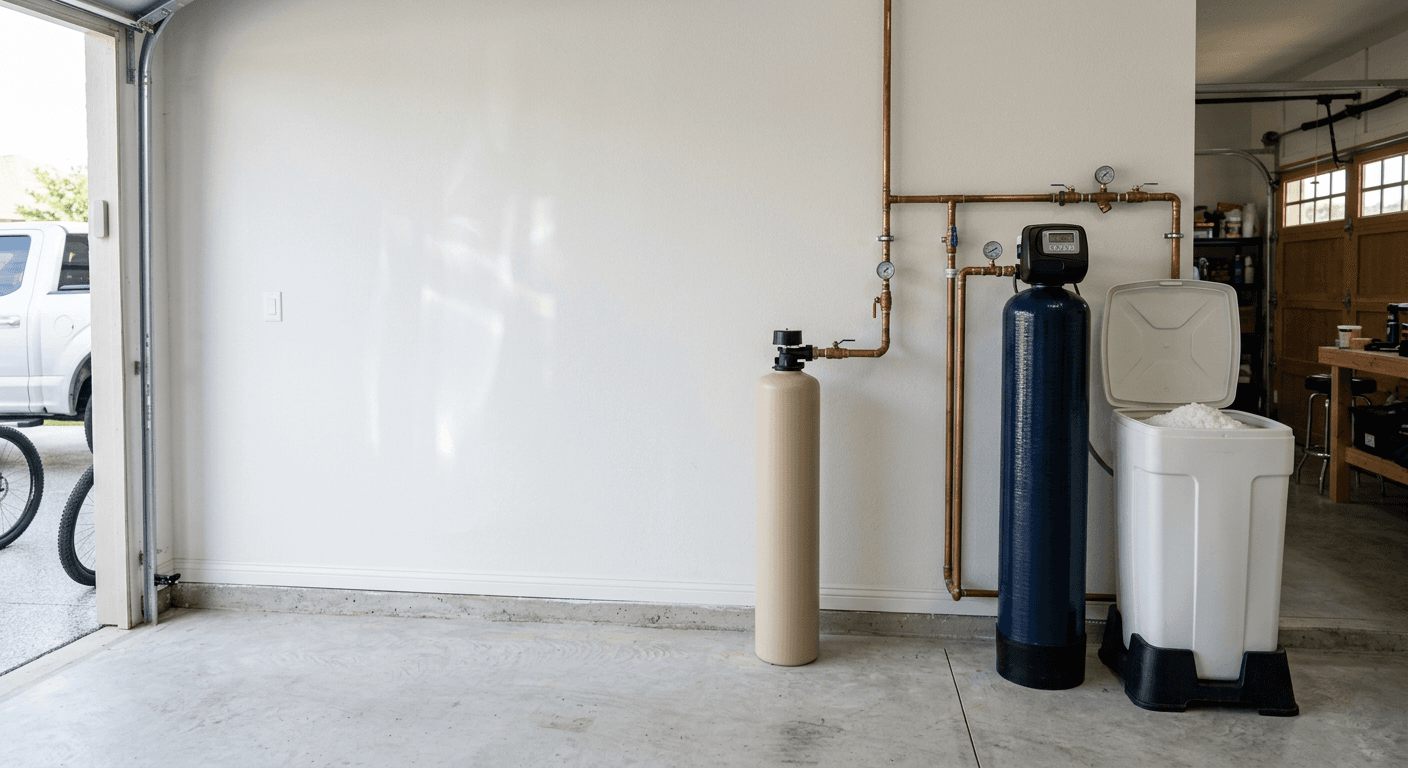
Comparison guide · Texas
Salt vs. Salt-Free Water Softeners: What’s the Difference?
Salt-based systems actually remove the minerals behind hard water. Most salt-free systems leave those minerals in place and try to reduce how they form scale.
Updated 14 min read
Quick answer · Salt vs. salt-free
Salt-based
Removes calcium and magnesium — genuinely soft water
Salt-free
Conditions minerals to limit scale — hardness remains
$1,200–$4,500
Typical installed range across both types
If you’re dealing with white buildup on faucets, cloudy dishes, soap scum, or mineral deposits inside appliances, understanding this difference can save you from buying the wrong equipment. Not sure you have hard water? Start with the 7 signs of hard water.
Traditional salt-based water softeners use ion exchange to reduce calcium and magnesium. Salt-free water conditioners typically use a different process intended to make those minerals less likely to form stubborn deposits. Both approaches have advantages, but they don’t deliver identical results.
For homeowners comparing a salt vs. salt-free water softener, the right choice depends on water hardness, household priorities, maintenance preferences, and what you actually want to improve. Here’s what you should know before investing in either system.
Salt vs. Salt-Free Water Softener: Quick Comparison
Before getting into the details, here’s how these two water treatment technologies compare.
| Feature | Salt-based softener | Salt-free conditioner |
|---|---|---|
| Removes hardness minerals | Yes | No, generally |
| Reduces actual water hardness | Yes | No |
| Reduces mineral scale | Yes | Potentially, depending on the system |
| Improves traditional soap lather | Yes | Not significantly |
| Reduces hardness-related water spots | Yes | Less reliably |
| Requires salt refills | Yes | No |
| Requires regeneration | Yes | Usually not |
| Produces regeneration wastewater | Yes | Usually not |
| Adds sodium through treatment | With sodium chloride regeneration | No sodium added by typical TAC systems |
| Maintenance | Salt, cleaning, servicing | Media replacement and servicing |
| Typical installed cost | $1,200–$3,800 | $1,500–$4,500 |
The salt-free comparison refers primarily to template-assisted crystallization (TAC) conditioners. Other salt-free technologies differ. Prices are national planning estimates, not guaranteed installation quotes.
The key takeaway: If your goal is genuinely soft water, a traditional ion-exchange softener is generally the better option. If your main goal is limiting certain scale deposits without handling salt or regeneration wastewater, a salt-free conditioner may be worth considering.
What a standard hardness test shows
The same incoming water, tested three ways.
Untreated water
Your baseline hardness
Calcium and magnesium as they arrive from the supply.
After a salt-based softener
Substantially lower
Ion exchange removes hardness minerals, so the test result drops.
After a salt-free TAC conditioner
About the same as untreated
Minerals stay in the water; the system aims to change how they form scale.
How Does a Salt-Based Water Softener Work?
Traditional water softeners use a process called ion exchange. Hard water contains dissolved calcium and magnesium. These minerals are responsible for many of the problems homeowners associate with hard water.
As water enters the softener, it passes through a tank containing specialized resin beads. The resin captures calcium and magnesium ions and replaces them with sodium or potassium ions. This produces water with a substantially lower hardness level.
Over time, the resin’s ability to capture hardness minerals becomes exhausted. The system then regenerates using a concentrated salt solution, commonly called brine. Regeneration removes the accumulated hardness minerals from the resin and discharges them with wastewater. Once this process is complete, the softener can continue treating incoming water.
Benefits of a salt-based water softener
Because salt-based systems actually reduce hardness, they can address several household problems at once. Potential benefits include:
- Less mineral scale on faucets and showerheads
- Reduced hardness-related spotting on dishes
- Less soap scum in showers and bathtubs
- Improved performance of traditional soaps and detergents
- Reduced new scale formation inside water heaters and appliances
- More consistent hardness reduction when properly sized and maintained
A properly functioning salt-based system can make a noticeable difference in homes experiencing significant hardness problems. Explore our water softener installation service.
Disadvantages of salt-based water softeners
Traditional softeners require ongoing attention. Homeowners need to replenish salt, maintain the brine tank, and periodically service the equipment. The regeneration process also uses water and discharges brine into the wastewater system.
Additionally, sodium-based ion exchange increases the sodium concentration of treated water. The amount added depends on incoming hardness and how much calcium and magnesium are removed. For households where sodium intake is a concern, a separate drinking-water treatment option may be appropriate.
Despite these considerations, conventional ion-exchange softening remains an established method for reducing actual water hardness.
How Does a Salt-Free Water Softener Work?
Here’s something important that many product descriptions don’t clearly explain.
Most salt-free water softeners aren’t technically water softeners. They’re water conditioners. They generally don’t remove calcium or magnesium from the water.
Instead, certain systems use technology intended to reduce the tendency of those minerals to form hard scale deposits. One commonly marketed approach is template-assisted crystallization, or TAC.
What is template-assisted crystallization?
TAC systems use specialized media intended to encourage dissolved hardness minerals to form microscopic crystals. The goal is for those minerals to remain suspended or move through the plumbing system rather than accumulating as hard deposits on surfaces.
Because the calcium and magnesium remain in the treated water, a conventional hardness test will generally still show similar hardness levels before and after treatment. That’s a major difference from a salt-based system.
TAC systems can reduce scale under certain conditions, but their effectiveness depends on the equipment, water chemistry, flow, and application. A salt-free conditioner shouldn’t be expected to deliver the same results as conventional water softening.
Do Salt-Free Water Softeners Actually Work?
Some do, for particular scale-control applications. Independent research has found that certain alternative treatment technologies can reduce scale formation — but results differ between studies.
2014
WateReuse Research Foundation · Arizona State University
Reported substantial scale reduction from template-assisted crystallization under its tested conditions.
2019
University of Waterloo
Found more modest scale-reduction results in its particular testing.
These findings help illustrate why performance should be evaluated by product and application rather than assumed from the term salt-free. Salt-free treatment may help limit certain deposits, but it doesn’t necessarily eliminate spots on shower glass, improve soap lather, or resolve every hard water complaint.
Benefits of salt-free water conditioners
Depending on the technology, benefits may include:
- No salt purchases or brine tank refills
- No traditional salt regeneration cycle
- No regeneration wastewater from passive TAC equipment
- No sodium added through TAC treatment
- Potential reduction in certain forms of scale buildup
- Less routine attention than conventional salt-based systems
Some passive systems also operate without electricity. However, not every product marketed as salt-free uses the same technology or has the same maintenance requirements.
Disadvantages of salt-free water conditioners
The most important limitation is that calcium and magnesium remain in the water. As a result, you may continue to experience some hard water effects. For example, traditional soap may still react with hardness minerals. Water spots can remain visible when droplets evaporate on glass or fixtures.
A salt-free conditioner also may not perform well when the incoming water contains substances that interfere with its treatment media. If you’re considering salt-free equipment, verify the manufacturer’s water chemistry limits and independent performance testing.
Which Works Better for Hard Water?
For actually reducing water hardness, a salt-based water softener is the more direct and established choice.
Consider a home with water hardness measuring 18 grains per gallon (GPG). That’s classified as very hard water by the U.S. Geological Survey. A properly sized salt-based softener can substantially reduce the calcium and magnesium concentration. A conventional salt-free TAC conditioner generally leaves the hardness level close to its original measurement, even if it changes how some mineral deposits form.
This distinction matters because homeowners experience hard water in several different ways.
If you have white mineral buildup
Both technologies may help with certain scale problems. A salt-based softener reduces the minerals available to form new scale. A salt-free conditioner may reduce scale formation under the conditions for which it’s designed and tested. However, neither system automatically removes years of existing deposits.
If your dishes have water spots
A salt-based water softener is generally more likely to improve hardness-related spotting because it reduces the minerals left behind when water evaporates. A salt-free conditioner leaves most of those minerals in the water. That means visible spots may continue even when the equipment provides some scale-control benefit.
If soap doesn’t lather well
Salt-based softening is the better choice. Calcium and magnesium interfere with the performance of traditional soaps. Because salt-free conditioners generally don’t remove those minerals, they shouldn’t be expected to deliver the same improvement in soap lather.
If you’re concerned about water heater scale
Both technologies deserve consideration, but for different reasons. Conventional softening limits the hardness minerals available to form scale. Certain salt-free conditioners may reduce scale formation on heated surfaces, depending on certified performance and water conditions. Before choosing equipment primarily to protect a water heater, ask for evidence relevant to that application.
Which Is Better for Texas Homes?
Many Texas communities have mineral-rich water supplies, although hardness levels vary considerably. Homes in Waco, Austin, San Antonio, Dallas, Houston, and other communities can have different water conditions based on their sources and local infrastructure. That makes testing important before selecting equipment.
When salt-based softening makes sense in Texas
A conventional softener may be the better option if your home has very hard water and you’re experiencing multiple hardness-related problems. For example, if you regularly deal with white scale on bathroom fixtures, cloudy dishes, and recurring soap scum, a system that actually reduces hardness is likely to provide more comprehensive benefits.
A salt-based softener is also worth considering when reducing scale inside appliances is a major priority.
When salt-free conditioning may make sense
A salt-free system may be worth evaluating if your main concern is scale control and you strongly prefer avoiding salt refills or regeneration wastewater. It may be a reasonable option for some households where water chemistry falls within the manufacturer’s specified operating range.
However, if the primary problem is poor soap performance or you want genuinely softened water, a conditioner may not deliver the results you’re expecting.
What about private well water?
Private well water requires particular attention. Some wells contain iron, manganese, sediment, or other substances that may interfere with water treatment equipment. Certain salt-free media systems require pretreatment or have specific limits for these substances. Traditional softeners can also experience resin fouling when water contains elevated iron or other problematic constituents.
Test the water before purchasing either system. Neither a conventional softener nor a salt-free scale conditioner should be assumed to make contaminated water safe to drink.
Salt vs. Salt-Free Water Softener Cost: Which Is Cheaper?
Cost is another major consideration. According to published national pricing estimates, salt-based water softeners typically cost between $1,200 and $3,800 installed. Salt-free systems commonly fall between $1,500 and $4,500 installed.
| Cost factor | Salt-based softener | Salt-free conditioner |
|---|---|---|
| Estimated installed cost | $1,200–$3,800 | $1,500–$4,500 |
| Salt purchases | Required for conventional systems | Not required |
| Regeneration water | Required | Not for typical passive TAC units |
| Media replacement | May eventually be required | Required according to media life |
| Plumbing modifications | May be necessary | May be necessary |
| Long-term service | Yes | Yes, generally less frequent |
These are budgeting ranges, not fixed Texas prices.
Installation costs depend on equipment capacity, plumbing accessibility, treatment requirements, and local labor rates. A home with an existing water softener loop may cost less to equip than a home requiring new connections.
Are salt-free systems cheaper over time?
They can have lower routine operating expenses because they don’t require softener salt or conventional regeneration water. But that doesn’t automatically make them cheaper overall. Salt-free media requires periodic replacement, and some products have higher upfront equipment costs.
A conventional salt-based system may also deliver benefits that a conditioner cannot, such as improved soap performance. Comparing costs only makes sense when you consider the results each system provides.
How much does water softener salt cost?
Published homeowner pricing guides estimate that salt or potassium purchases for conventional water softeners may cost approximately $50 to $150 annually. Actual expenses depend on water hardness, household consumption, equipment efficiency, and the type of regenerant.
A high-efficiency water softener can help reduce salt consumption. For homeowners wanting to minimize operating costs, choosing efficient equipment and proper sizing is important. For a detailed cost breakdown, read How Much Does Water Softener Installation Cost in Texas?
Which Requires Less Maintenance?
Salt-free conditioners generally require less routine attention than conventional salt-based systems, particularly when they use passive treatment media. However, neither is completely maintenance-free.
Maintaining a salt-based water softener
Routine tasks include checking salt levels, preventing salt bridges, cleaning the brine tank, and monitoring performance. The EPA recommends considering demand-initiated regeneration rather than relying exclusively on a fixed schedule. Demand-initiated systems regenerate based on water usage or remaining treatment capacity, which can help reduce unnecessary salt and water consumption.
Maintaining a salt-free water conditioner
Salt-free systems don’t typically require salt refills. However, the treatment media has a limited service life. Depending on the equipment, maintenance may involve replacing media or cartridges, cleaning sediment prefilters, and inspecting flow performance. Some products may need additional maintenance when source water conditions are challenging.
Before purchasing, ask how often the treatment media must be replaced and what replacement will cost.
Are Salt-Based Water Softeners Bad for the Environment?
Conventional water softeners can have environmental impacts because regeneration uses water and discharges dissolved salts into wastewater. Sodium and chloride discharged during regeneration can affect wastewater treatment and water reuse considerations. Some local jurisdictions place restrictions on particular softener configurations or discharges.
However, not every softener uses the same amount of salt or water. Newer demand-initiated systems can be more efficient than older timer-based equipment. The EPA recommends evaluating both water efficiency and salt efficiency when purchasing a conventional softener.
Salt-free TAC systems avoid conventional brine regeneration, which can reduce these particular environmental impacts. But environmental impact isn’t the only factor in selecting equipment. The system must also accomplish your treatment goals.
Do Salt-Based Water Softeners Make Water Salty?
A properly operating conventional softener doesn’t normally make water taste like saltwater. Salt is used to regenerate the resin, while sodium or potassium ions are exchanged for hardness minerals during normal treatment.
With sodium chloride regeneration, softened water contains more sodium than the untreated water. The amount added increases with the amount of hardness removed. For most homeowners, this is primarily a consideration when evaluating drinking-water preferences or sodium intake.
If someone in your household must restrict sodium, discuss appropriate drinking-water options with their healthcare professional. Potential alternatives include a separate unsoftened drinking-water line or an appropriately selected reverse osmosis system.
Is potassium chloride a salt-free alternative?
No. Potassium chloride is itself a salt. Some conventional ion-exchange water softeners can use potassium chloride instead of sodium chloride. That allows the system to continue removing hardness minerals while exchanging them for potassium rather than sodium.
However, the softener still regenerates and produces wastewater. It should not be confused with a salt-free TAC water conditioner.
How to Decide Between a Salt and Salt-Free Water Softener
The best choice starts with understanding your water and what you want to improve.
| Your main priority | Option to investigate |
|---|---|
| Reduce actual water hardness | Salt-based softener |
| Improve traditional soap lather | Salt-based softener |
| Reduce mineral spotting on dishes | Salt-based softener |
| Limit scale without salt refills | Verified salt-free conditioner |
| Avoid brine regeneration | Salt-free conditioner |
| Treat very hard water with multiple symptoms | Salt-based softener |
| Reduce a harmful drinking-water contaminant | Appropriate certified filtration or other treatment |
Step 1: Test your water hardness
Before purchasing equipment, determine your incoming water hardness. The U.S. Geological Survey classifies water above approximately 10.5 GPG as very hard. However, classification alone doesn’t determine the right system. Consider your household’s actual symptoms and how much water you use. Our hardness result interpreter can help you read a test.
Step 2: Decide what results matter most
Are you primarily trying to prevent scale inside your water heater? Or are you frustrated by soap scum, mineral spots, and poor detergent performance? The difference matters. Salt-free treatment may address certain scale concerns, but it isn’t a direct substitute for actual hardness reduction.
Step 3: Review independent testing and certifications
For conventional cation-exchange water softeners, NSF/ANSI 44 is an important standard. It addresses water softener performance, including hardness reduction, capacity, and other equipment requirements. For scale-reduction devices, IAPMO/ANSI Z601-2025 provides requirements for specified residential scale-control applications.
If a product advertises NSF/ANSI/CAN 61 certification, understand that the standard primarily concerns the health effects of materials in contact with drinking water. It doesn’t, by itself, prove that a conditioner removes hardness or prevents scale. Always verify the exact product’s certification and performance claims.
Step 4: Compare ownership costs
Request an estimate that includes equipment, installation, expected maintenance, and replacement materials. Ask how long the equipment is expected to last and whether replacement parts will be readily available. A system that’s cheaper upfront may not be the best investment if it doesn’t solve your original problem.
Step 5: Confirm installation requirements
Both types of equipment typically connect to the home’s main water supply. Conventional salt-based systems also need appropriate drainage for regeneration. Texas regulates certain contracted water treatment installation activities through the Texas Commission on Environmental Quality. Confirm that the installer has the appropriate credentials for the work and will follow applicable plumbing and permitting requirements. See what to expect during installation.
Frequently Asked Questions About Salt vs. Salt-Free Water Softeners
Is a salt-free water softener as good as a salt-based one?
Not for actual hardness removal. Salt-based softeners remove calcium and magnesium, while typical salt-free conditioners leave those minerals in the water.
Certain salt-free systems can reduce scale, but they don’t deliver identical softening benefits.
Do salt-free water softeners really work?
Some salt-free technologies have demonstrated scale-reduction performance in independent testing. Results vary by product, water chemistry, and application.
A salt-free conditioner should not be expected to eliminate all hard water symptoms or produce genuinely soft water.
Will a salt-free water softener remove white spots?
Not necessarily. Because hardness minerals remain in the water, mineral spots can still appear when water droplets evaporate.
A conventional salt-based softener generally provides more direct reduction of hardness-related spotting.
Which system is better for very hard water?
A properly sized conventional salt-based softener is generally more suitable when homeowners want significant hardness reduction.
Salt-free conditioners may have specific water chemistry limitations and shouldn’t be assumed to perform equally well at every hardness level.
Do salt-free systems need electricity?
Many passive TAC water conditioners operate without electricity. However, other salt-free technologies may require power.
Check the specifications for the particular product.
How long do salt-free water conditioners last?
The equipment housing may last for years, but the treatment media eventually needs replacement. Replacement schedules depend on the manufacturer, water conditions, and volume treated.
Follow the product’s maintenance instructions.
Can I replace my salt-based softener with a salt-free system?
Yes, in some installations, but expect different results. If your current softener reduces hardness effectively, replacing it with a conditioner will generally leave calcium and magnesium in your water.
Make the decision based on which benefits you want to retain.
Do salt-free water softeners remove chlorine?
Not necessarily. A typical TAC conditioner isn’t intended to remove chlorine or function as a comprehensive filtration system. Some packages combine salt-free conditioning with activated carbon filtration.
Verify each treatment stage and its specific contaminant-reduction claims.
For more on filtration, see Water Softener vs. Water Filter: Which Does Your Home Need?
The Bottom Line: Salt or Salt-Free?
Salt-based and salt-free systems can both have a place in residential water treatment, but they solve different problems.
- Salt-based water softeners are generally the better choice when you want to remove hardness minerals and address multiple hard water symptoms.
- Salt-free water conditioners may be worth considering when your primary objective is scale control and you prefer to avoid salt refills and brine regeneration.
Neither system is automatically right for every home. If your water is only moderately hard and you rarely experience scale or soap problems, you may not need either one.
The smartest approach is to test your water, identify your actual treatment goals, and compare equipment based on verified performance. That’s how you avoid paying for a system that doesn’t deliver the results you expected.
Not Sure Which Water Treatment System Is Right? Ask Clearly Water Systems.
Choosing between a salt-based water softener and a salt-free conditioner shouldn’t come down to marketing claims or guesswork. At Clearly Water Systems, we believe water treatment decisions should start with understanding your home’s water conditions and the problems you want to solve.
Whether you’re dealing with significant mineral buildup, exploring low-maintenance treatment options, or comparing whole-home systems, the right information can make the decision easier.
Last reviewed: November 2026. Equipment costs are general national estimates. Water treatment performance and installation requirements depend on actual water conditions, equipment specifications, and applicable local requirements.
Sources and further reading
- U.S. Environmental Protection Agency — Cation Exchange Water Softeners
- U.S. Geological Survey — Hardness of Water
- NSF — NSF/ANSI 44 Residential Cation Exchange Water Softeners
- EPA — WaterSense Guide to Selecting Water Treatment Systems
- WateReuse Research Foundation — Evaluation of Alternatives to Domestic Ion Exchange Water Softeners
- University of Waterloo — Drinking Water Softening/Scale Prevention Technology Assessment
- IAPMO — Z601-2025 Scale Reduction Devices
- HomeGuide — Water Softener Installation Cost
- TCEQ — Water Treatment Specialist Licensing